Why Balance Training Feels Hard at First — And What Most People Get Wrong
You don’t need to be an athlete to benefit from better balance — everyday movements depend on it. Yet many of us overlook this quiet superpower until we stumble or feel unsteady. I used to think balance was just for older adults or yogis, but after testing simple routines myself, I noticed real improvements — not just physically, but in confidence too. Turns out, most people miss key mistakes that actually slow progress. Let’s break down what really undermines balance training and how to fix it the right way.
The Hidden Role of Balance in Daily Life
Beyond standing on one foot or walking a straight line, balance is a foundational bodily function that supports nearly every movement we make. It allows us to shift weight smoothly, adjust posture during motion, and react to changes in terrain without falling. Whether you're climbing stairs with a laundry basket, reaching for a spice jar on a high shelf, or stepping off a curb while holding your child’s hand, balance is working behind the scenes. These actions may seem automatic, but they rely on a complex network of sensory feedback and muscular coordination that many take for granted.
What’s often overlooked is how silently balance declines with age. Unlike strength or endurance, which people notice fading over time, poor balance creeps in gradually. You might not realize it’s weakening until you trip on a rug or wobble getting out of the car. Research shows that even healthy adults begin to experience measurable declines in postural control as early as their 40s. This slow erosion increases the risk of falls — a leading cause of injury among middle-aged and older adults — but it doesn’t have to be inevitable.
Balance is not just about safety; it’s deeply tied to independence. The ability to move confidently through daily life — carrying groceries, gardening, or playing with grandchildren — depends heavily on stable coordination. When balance weakens, people may subconsciously limit their activities, leading to reduced mobility and a more sedentary lifestyle. Over time, this creates a cycle where less movement leads to further decline, reinforcing the need to proactively maintain this essential skill long before problems arise.
Common Misconceptions That Hold People Back
One of the biggest barriers to effective balance training is misunderstanding what balance truly is and who benefits from it. A widespread myth is that balance work is only necessary for seniors or those recovering from injury. In reality, balance is a dynamic ability that everyone uses and can improve at any age. Another common belief is that some people are simply “clumsy” and can’t get better — a mindset that discourages effort before it begins. But science confirms that balance is not a fixed trait; it’s a trainable system, much like muscle strength or flexibility.
Some assume that because they haven’t fallen, their balance must be fine. However, the absence of falls doesn’t mean the system is functioning optimally. Just as high blood pressure often has no symptoms, poor balance can go unnoticed until a misstep leads to injury. Others believe that balance improves automatically through general exercise like walking or cycling. While these activities support cardiovascular health, they don’t sufficiently challenge the specific systems responsible for stability, especially when performed on predictable, flat surfaces.
Another misconception involves overreliance on vision. Many people unknowingly depend too much on what they see to stay upright, neglecting the crucial roles of the inner ear and proprioception — the body’s sense of where it is in space. When vision is removed — such as in dim lighting or when looking down — their balance falters. This dependence reveals an imbalance in sensory reliance that training can correct. Recognizing these myths is the first step toward building a more effective and inclusive approach to balance that benefits everyone, regardless of age or fitness level.
The Biggest Pitfalls in Balance Training (And Why They Backfire)
Even well-intentioned balance practice can fall short when common errors go unaddressed. One of the most frequent mistakes is rushing through exercises without focusing on form. People often try to hold a single-leg stance for 30 seconds but do so while swaying excessively or gripping the floor with their toes. This kind of movement reinforces poor patterns rather than building true stability. Balance training requires precision, not speed or duration. Performing movements slowly and with control allows the nervous system to learn proper alignment and muscle engagement.
Another pitfall is training exclusively on stable, flat surfaces like hardwood or tile floors. While these are appropriate starting points, they don’t challenge the body enough to create meaningful improvement. Real-world environments are rarely perfectly even — sidewalks crack, grass is uneven, floors can be slippery. To prepare for these variations, balance exercises should gradually introduce instability, such as using a folded towel, foam pad, or balance disc. Without this progression, the body never adapts to less predictable conditions, limiting functional gains.
Distracted training is another major issue. Many attempt balance drills while watching TV, scrolling on their phones, or multitasking in the kitchen. But balance requires focused attention. The brain needs to process sensory input and coordinate muscle responses in real time. Dividing attention weakens neural connections and reduces the effectiveness of the workout. Additionally, treating balance as an afterthought — tacking on a few seconds of standing on one leg at the end of a workout — prevents consistent progress. Like any skill, balance thrives on regular, dedicated practice rather than occasional, fragmented efforts.
How the Body Actually Maintains Balance: A Simple Science Breakdown
Balancing isn’t magic — it’s a coordinated effort between three key systems: the vestibular system in the inner ear, proprioception from muscles and joints, and visual input from the eyes. Think of them as a team where each member has a unique role. The inner ear detects head motion and spatial orientation, helping you know which way is up. Proprioception provides feedback about limb position and muscle tension, telling your brain where your feet and legs are without needing to look. Vision offers environmental cues, such as distance to objects or surface texture. When all three communicate clearly, balance feels effortless.
When one system falters, the others compensate — but only to a point. For example, standing with your eyes closed immediately increases difficulty because the brain loses visual input and must rely more heavily on the inner ear and foot sensors. If those systems are undertrained or weakened by inactivity, the result is wobbling or loss of balance. This interdependence explains why some people feel dizzy when turning their head quickly or struggle on soft surfaces like sand — their systems aren’t working together efficiently.
Aging and sedentary lifestyles can dull the connections between these systems. Prolonged sitting reduces joint mobility and muscle responsiveness, weakening proprioceptive signals. Lack of varied movement limits the brain’s ability to process balance challenges, making reactions slower. The good news is that these systems remain adaptable throughout life. Targeted exercises that challenge each component — such as head turns, uneven surfaces, or brief eye closures — strengthen communication between them. Over time, this integration leads to smoother, more confident movement in everyday situations.
Smart Ways to Train Balance Without Wasting Time
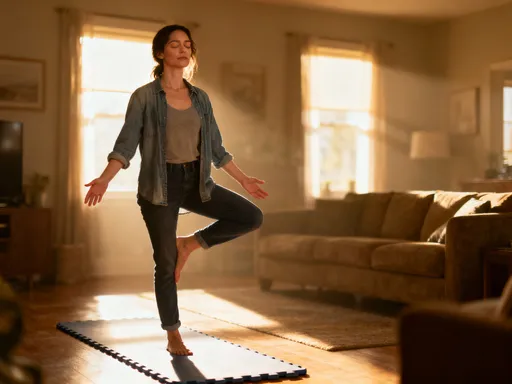
Effective balance training doesn’t require special equipment or hours of practice. The key is consistency and smart progression. Start with foundational exercises like the tandem stance — standing with one foot directly in front of the other, heel to toe — or single-leg stands, holding the position for 20 to 30 seconds per side. These simple movements engage core stabilizers and improve weight distribution. As they become easier, introduce subtle challenges: close your eyes for a few seconds, turn your head side to side, or stand on a folded bath towel to create mild instability.
Walking drills are also powerful. Try heel-to-toe walks along a straight line, focusing on placing one foot directly in front of the other. This mimics the narrow base of support used when navigating tight spaces or uneven ground. Perform this slowly, with arms out for support if needed. Another effective method is the clock reach: stand on one leg and imagine a clock face around you. Gently reach your opposite foot toward 12, 3, 6, and 9 o’clock positions, using control and balance. These movements enhance dynamic stability — the ability to stay balanced while moving.
Integrating balance into daily routines maximizes results without adding extra time. Brush your teeth while standing on one leg. Wait for the microwave or coffee to brew while shifting weight from foot to foot. Stand on a foam pad or folded blanket during phone calls. These micro-practices accumulate over time, reinforcing neural pathways and muscle memory. Aim for just 5 to 10 minutes of intentional balance work each day rather than longer, infrequent sessions. Short, frequent exposure trains the brain more effectively and fits easily into a busy schedule.
When to Seek Help — And Why It’s Not Just About Fitness
While balance can be improved through training, persistent instability may signal underlying health concerns that require professional evaluation. Frequent tripping, unexplained dizziness, or a fear of walking on uneven surfaces shouldn’t be dismissed as normal aging. These symptoms could indicate issues with the inner ear, neurological function, medication side effects, or musculoskeletal conditions. If balance problems interfere with daily activities or increase fall risk, consulting a healthcare provider is essential before beginning a training program.
A physical therapist or primary care provider can assess the root cause of imbalance and recommend appropriate interventions. They may perform tests to evaluate vestibular function, joint mobility, muscle strength, and coordination. In some cases, specialized rehabilitation programs are needed to address specific deficits. For example, vestibular therapy can help retrain the inner ear after dizziness episodes, while strength training may be necessary if leg weakness contributes to instability. Medical guidance ensures that balance efforts are safe and targeted to individual needs.
It’s important to recognize that balance training complements, but does not replace, medical care. While exercise can significantly improve stability, it cannot correct certain medical conditions on its own. Taking symptoms seriously and seeking timely evaluation prevents complications and supports long-term well-being. Viewing balance as part of overall health — not just physical fitness — encourages a proactive, informed approach that prioritizes safety and function.
Building Long-Term Stability: Making Balance Part of Your Lifestyle
Lasting improvement in balance comes not from intense workouts, but from consistent, everyday practice. Like brushing your teeth or wearing a seatbelt, balance training is a form of preventive care — small actions that protect your body over time. Intensity matters less than regularity. Five minutes a day of mindful standing, controlled movement, or simple challenges add up to meaningful change. The brain and body adapt gradually, forming stronger neural connections and more responsive muscles with repetition.
Over months, this consistency translates into greater confidence and independence. You may notice it when carrying a heavy pot from the stove, stepping onto a moving escalator, or hiking a trail with roots and rocks. These moments reflect the real-world value of balance — not as a performance metric, but as a foundation for living fully. As we age, maintaining this ability becomes even more critical, preserving mobility and reducing reliance on others for daily tasks.
Shifting your mindset helps sustain the habit. Instead of seeing balance as an optional add-on, view it as a vital part of health, like nutrition or sleep. It’s never too early or too late to start. Whether you’re in your 30s, 50s, or beyond, your body responds to challenge and improves with care. By treating balance as a lifelong skill, you invest in a future where movement remains easy, safe, and joyful. Your body will thank you — one steady step at a time.